Case Study 03: Learning Game
Key Odyssey
Mastery-gated typing, eight worlds deep
Accessibility, verified. Key Odyssey passes automated WCAG 2.1 AA testing (axe-core) with zero violations on eleven screens, from the home screen and journey map to the placement check and a lesson in progress. Verified September 2026.
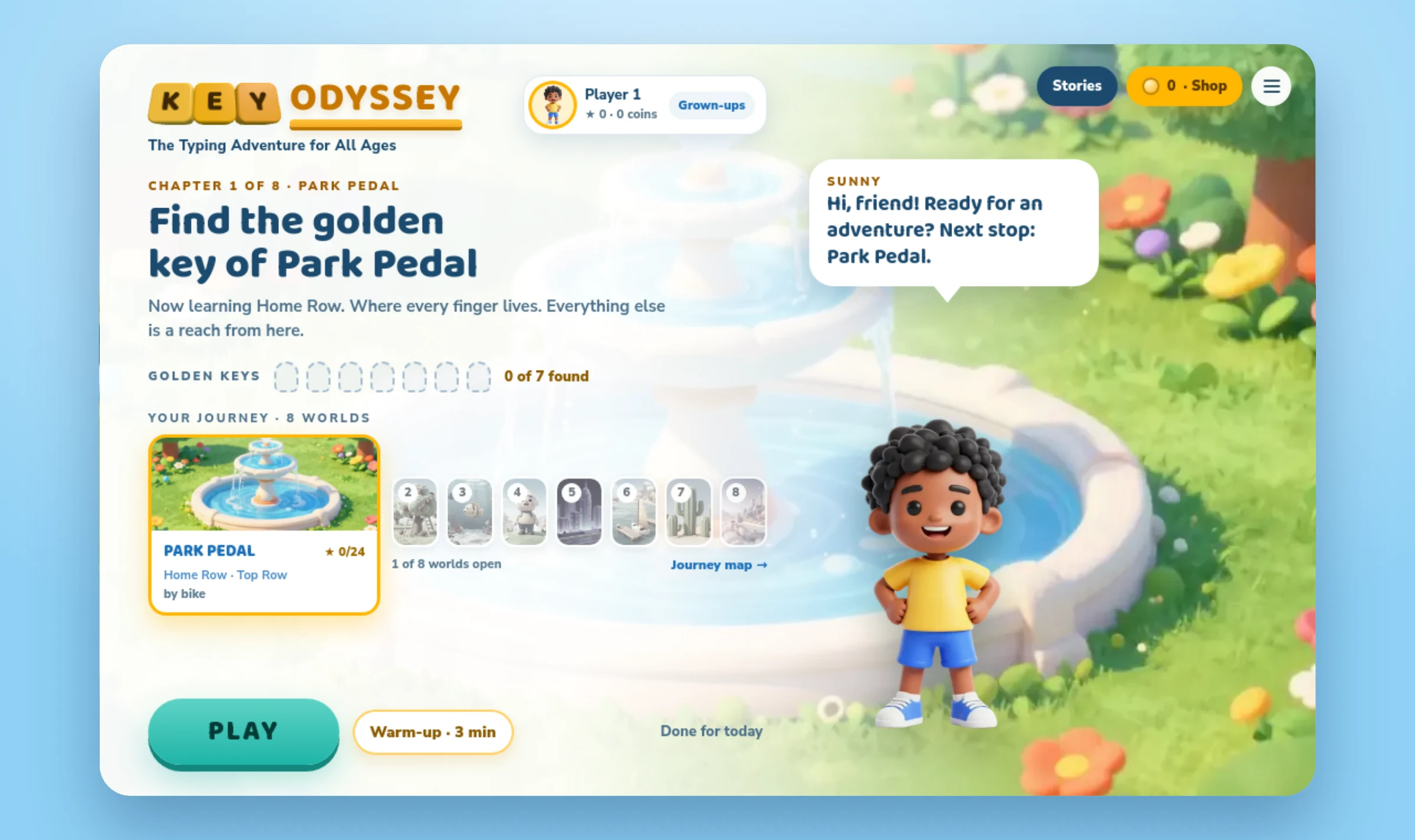 Play Key Odyssey
01: ANALYSIS
Typing is a psychomotor skill, and that changes everything downstream.
Most typing software is built as if the skill were declarative; learn where the keys are, then practise. The analysis started from the opposite premise, and the design follows from it.
- Learner analysis
- Two populations with nothing in common except the gap: children learning from zero, and adults who have typed for years with self-taught habits and cannot be sent back to “press F with your left index.” Any single fixed starting point insults one group and abandons the other, which is what made placement a requirement rather than a feature.
- Task analysis
- Fitts and Posner’s three stages set the structure: a cognitive phase where the learner thinks about each key, an associative phase where errors fall away, and an autonomous phase where typing runs without attention. Instruction is only useful in the first. Everything after it is scheduled practice, which means the design problem is what to practise next, not what to explain next.
- Root cause
- Learners do not abandon typing programs because the content is wrong. They abandon them because the sequence is indifferent to them: drilling keys already automatic while the two that actually break accuracy never resurface. The deficiency is in the scheduling logic, not the instruction.
- Constraints
- Browser-only, no install, playable in ten-minute sittings, and legible to a parent or teacher who was not in the room. Physical keyboards vary, so nothing could depend on a specific layout beyond the anchors. The mastery record had to be small enough to live in local storage and still support a printable report.
Learning objectives
- Imitate
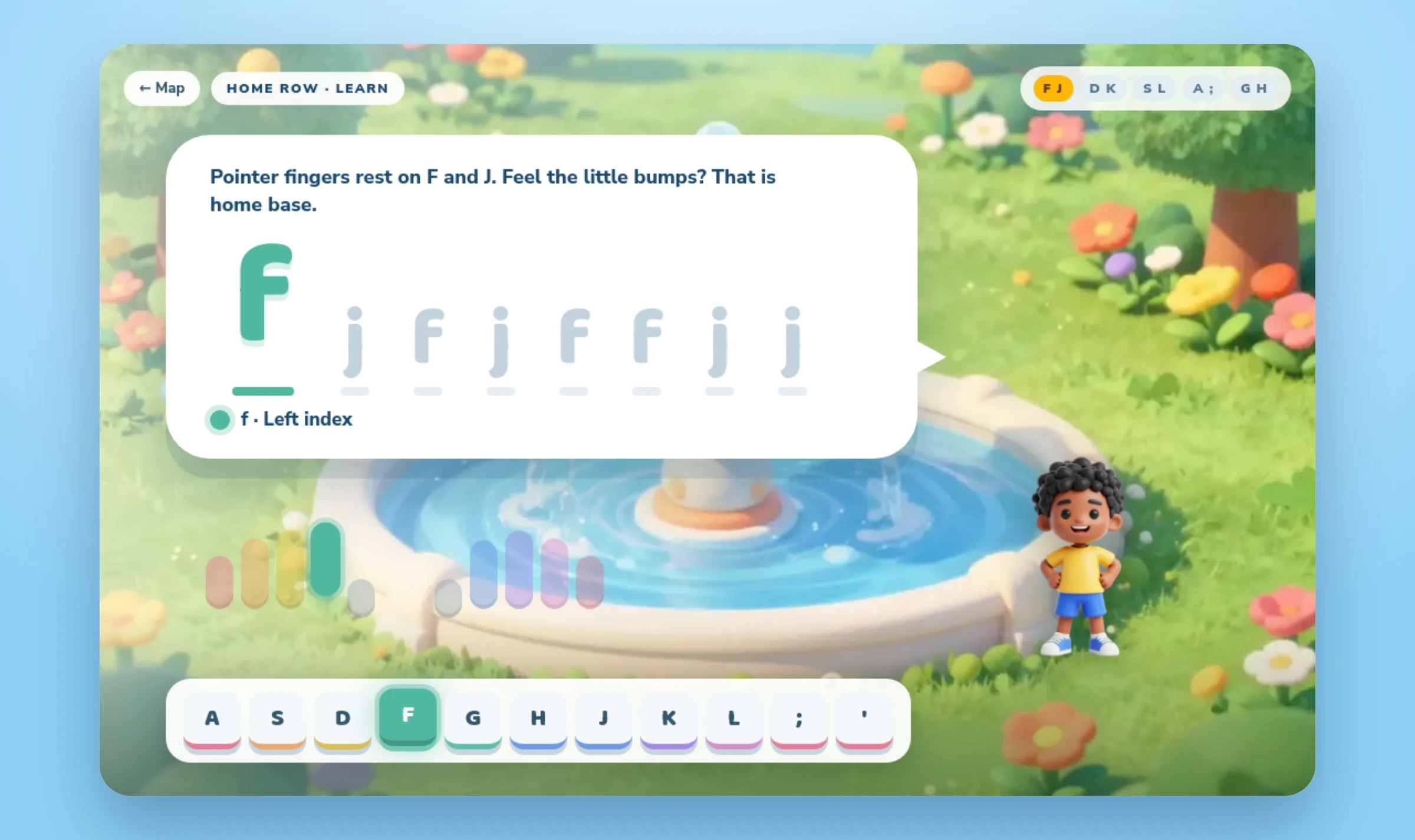
- The learner places both hands on the anchor keys without looking, and returns to them after reaching, on every attempt in a session.
- Practise
- For each world, the learner types its key set at the accuracy threshold required for two stars before the next world unlocks: accuracy gating speed, never the reverse.
- Automate
- The learner sustains accuracy on a mixed passage while the keyboard is hidden, evidence that the skill has left the cognitive stage and no longer requires visual confirmation.
- Terminal
- The learner types their own writing (an email, a homework paragraph) without looking down and without the game. Transfer to real work is the objective; words per minute is only its proxy.
Process model: mastery learning, built through successive approximation
Bloom’s mastery learning is the instructional spine: a fixed standard with variable time, corrective work before advancement, and no learner carried forward on a partial pass. Fitts and Posner’s stages determine what each world can reasonably ask for. The build itself ran iteratively: a Storyline prototype settled the placement and progression logic before any of it was written as a game, which is the cheapest place to discover that a gate feels punitive.
02: THE PROBLEM
Typing tutors drill everyone on the same keys at the same speed.
Most typing software runs a fixed sequence: home row, top row, bottom row, numbers. A learner who has already mastered the home row grinds through it anyway, and one who never got it is carried past it by the schedule rather than by evidence.
The design problem was making the curriculum answer to the learner instead of the calendar; and doing it for a range from six-year-olds to adults returning to the keyboard, without either group feeling like they were using the other’s product.
03: THE DESIGN
Progress you have to earn, in a world you want to finish.
01
Stars gate the route
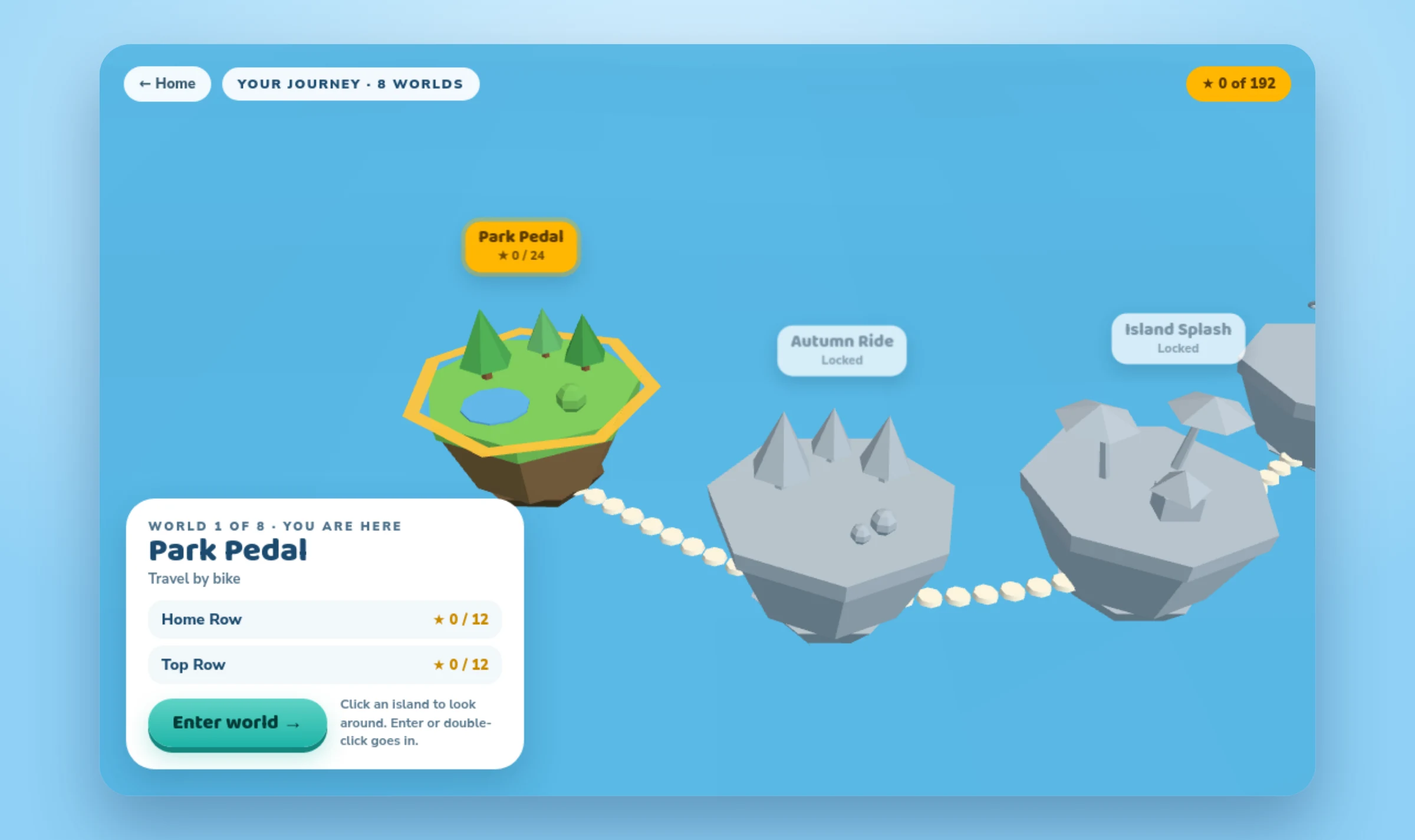
A world unlocks only when the previous one is earned at two stars. Advancement is evidence of mastery, not time served.
02
Decay-based drills
Keys a learner is starting to lose resurface inside the next journey’s words, so remediation happens in play rather than in a separate penalty exercise.
03
A placement test, not an assumption
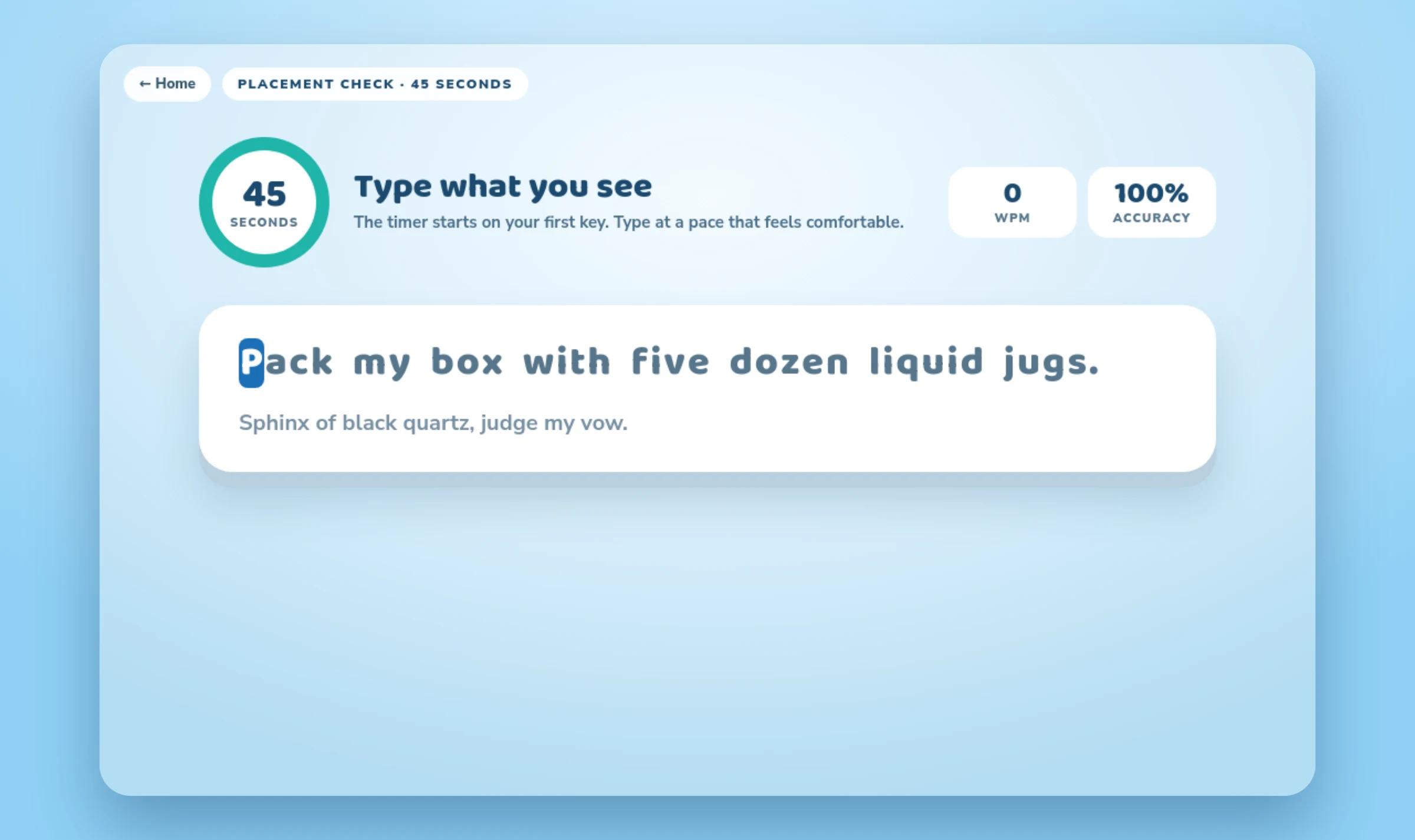
Forty-five seconds of real sentences sets the starting level, so an adult never begins at “press F with your left index.”
04: THE JOURNEY
Four surfaces, one mastery model.
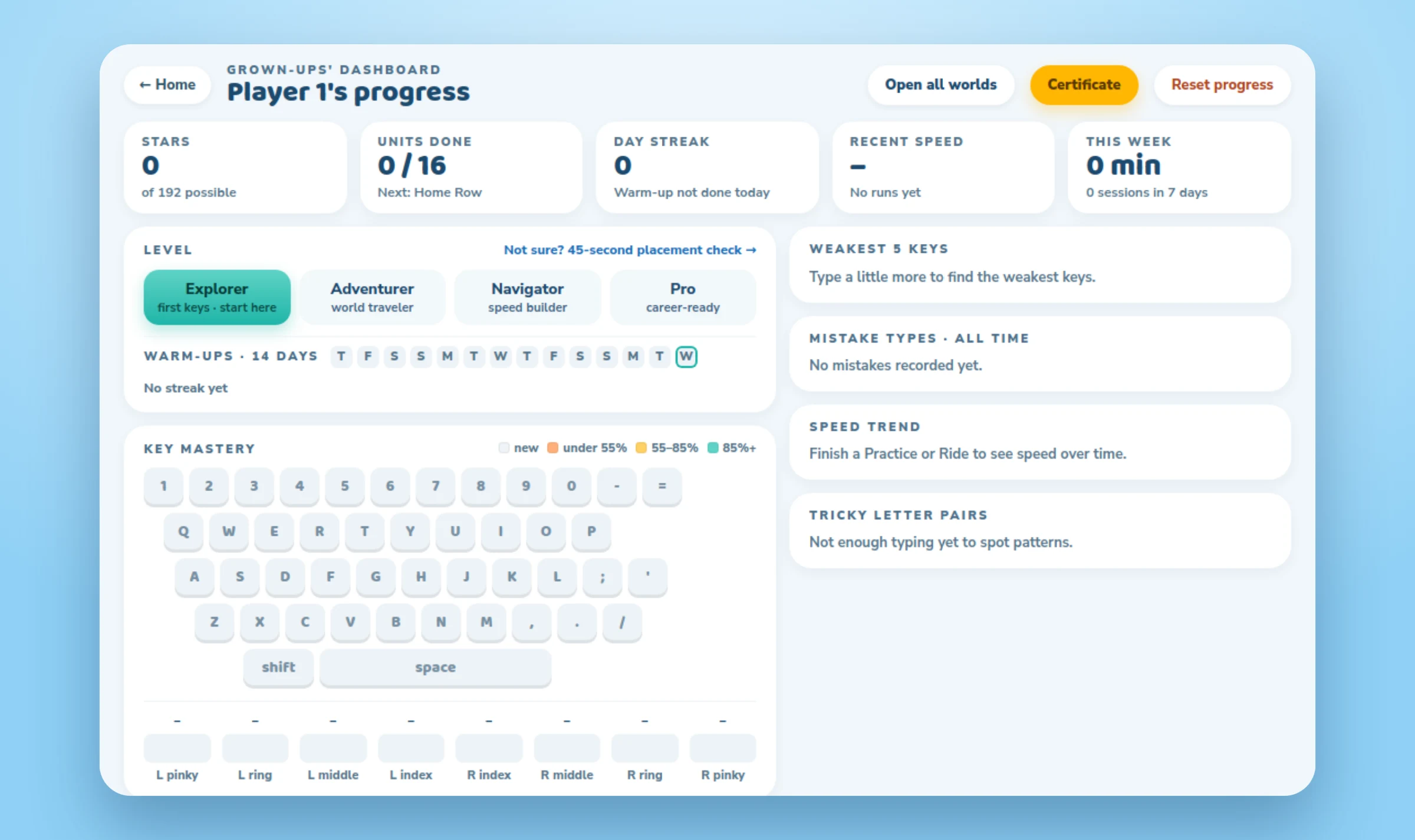
Every screen reads from the same record of what the learner can and cannot do.
05: OUTCOME
What shipped.
Eight worlds from first keys to career-ready, twenty-four stars earned on accuracy and speed, and four levels from Explorer to Pro riding one shared route.
Multi-student progress, CSV export, and a printable report make it usable by a classroom, not only a household.
06: EVALUATION
How I would know whether it worked.
Typing is unusually easy to measure and unusually easy to measure wrongly. Words per minute rises for weeks while a learner is still looking at the keyboard, so speed alone will report success on exactly the habit the design exists to prevent. This is a self-initiated portfolio piece; no classroom data has been collected.
| Level | Evidence | Status |
|---|---|---|
| 1: Reaction | Voluntary return, not enjoyment ratings. The signal that matters is whether a learner comes back after a session that ended in a failed gate; that is where a mastery design either holds or loses people. | Planned |
| 2: Learning | Accuracy per key against the two-star threshold, plus the shape of the error profile over time. The mastery record is the assessment, and the progress dashboard already renders it for a parent or teacher. | Built in |
| 3: Behaviour | The terminal objective: typing the learner’s own work outside the game, observed for whether they look down. A held accuracy rate on unfamiliar text is the honest test; words per minute on a familiar passage is not. | Planned |
| 4: Results | In a classroom, time reclaimed: how much of a writing period is spent hunting for keys rather than composing. That is the reason a school teaches typing at all, and it is measurable by observation. | Planned |
Formative testing
The Storyline prototype existed to answer one question early: does a two-star gate read as a fair standard or as a wall? The next thing I would watch is the placement test with adults: forty-five seconds is short enough to feel painless and short enough to misplace someone, and a learner dropped two worlds below their real level will quit before the design gets a chance to work.
A mastery gate is easier to judge from the inside. Take the placement test and see where it puts you.