Case Study 04: Learning Game
Spin & Find
Place-name recall that survives the weekend
 Play Spin & Find
01: ANALYSIS
Before anything was built, four questions.
Geography recall looks like a content problem and is almost always a scheduling problem. The analysis had to establish that before a single screen was designed.
- Learner analysis
- Ages 10–14, wide variance in prior knowledge within a single class. Shared or school-issued devices, no reliable individual logins, and practice windows of ten to fifteen minutes rather than full periods. Any design requiring an account or an install was ruled out at this stage, not discovered later.
- Task analysis
- The terminal task, label a blank map, decomposes into two distinct operations that are usually treated as one: recognition (given a name, find the place) and recall (given a place, produce the name). Each was specified as its own objective, because practising one does not reliably produce the other.
- Root cause
- Applying Mager and Pipe’s test: students can perform the task on the day it is taught, so this is not a skill deficiency and not an environmental or incentive problem. It is a retention failure. That finding is what makes practice scheduling the intervention rather than more or better instruction.
- Constraints
- Browser-only, no install, no login, and no teacher setup. Progress had to survive a closed tab on a shared machine, which pushed the mastery record to local storage and ruled out any design depending on a class roster.
Learning objectives
- Remember
- Given a location marked on the globe and four candidate names, the student selects the correct name on three consecutive presentations.
- Understand
- For each region, the student states one physical feature associated with it, providing a semantic anchor for the name.
- Apply
- Given the name of one of twelve world regions and an unlabelled globe, the student locates the region correctly on three consecutive presentations.
- Terminal
- Two weeks after last practice, the student labels at least ten of twelve regions on a blank map with no prompts. This is the objective the whole design is accountable to.
Process model: SAM (successive approximation)
A linear ADDIE pass was the wrong fit here: the core question, whether a three-in-a-row mastery criterion feels earned or punitive to an eleven-year-old, can only be answered by playing it. Analysis and objectives were fixed up front, then design, build, and review ran in short cycles against a working prototype. The learning science is Leitner’s spacing intervals, Bloom’s mastery criterion, and elaborative feedback in the Kulhavy tradition.
02: THE PROBLEM
Students could label a map on Friday and lose it by Monday.
Map-labeling worksheets test recognition once, in one direction, on the same day the material is taught. Nothing in the format asks a student to retrieve a place name after they have started to forget it; which is the only moment retrieval actually builds durable memory.
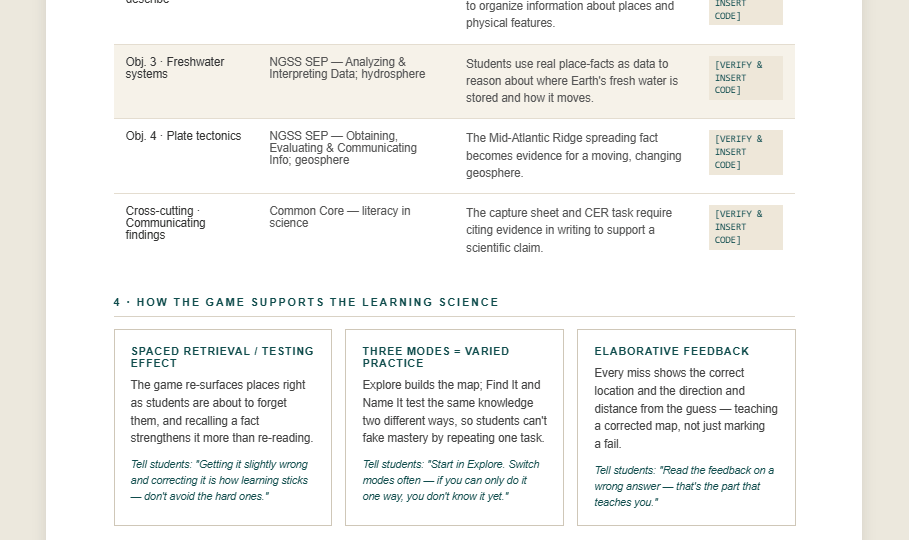
The design problem was not making geography prettier. It was scheduling: how do you re-surface a place at the point of near-forgetting, and how do you test the same knowledge in enough different directions that a student cannot fake mastery by repeating one task?
03: THE DESIGN
A Leitner box, hidden inside a globe.
01
Three correct picks in a row
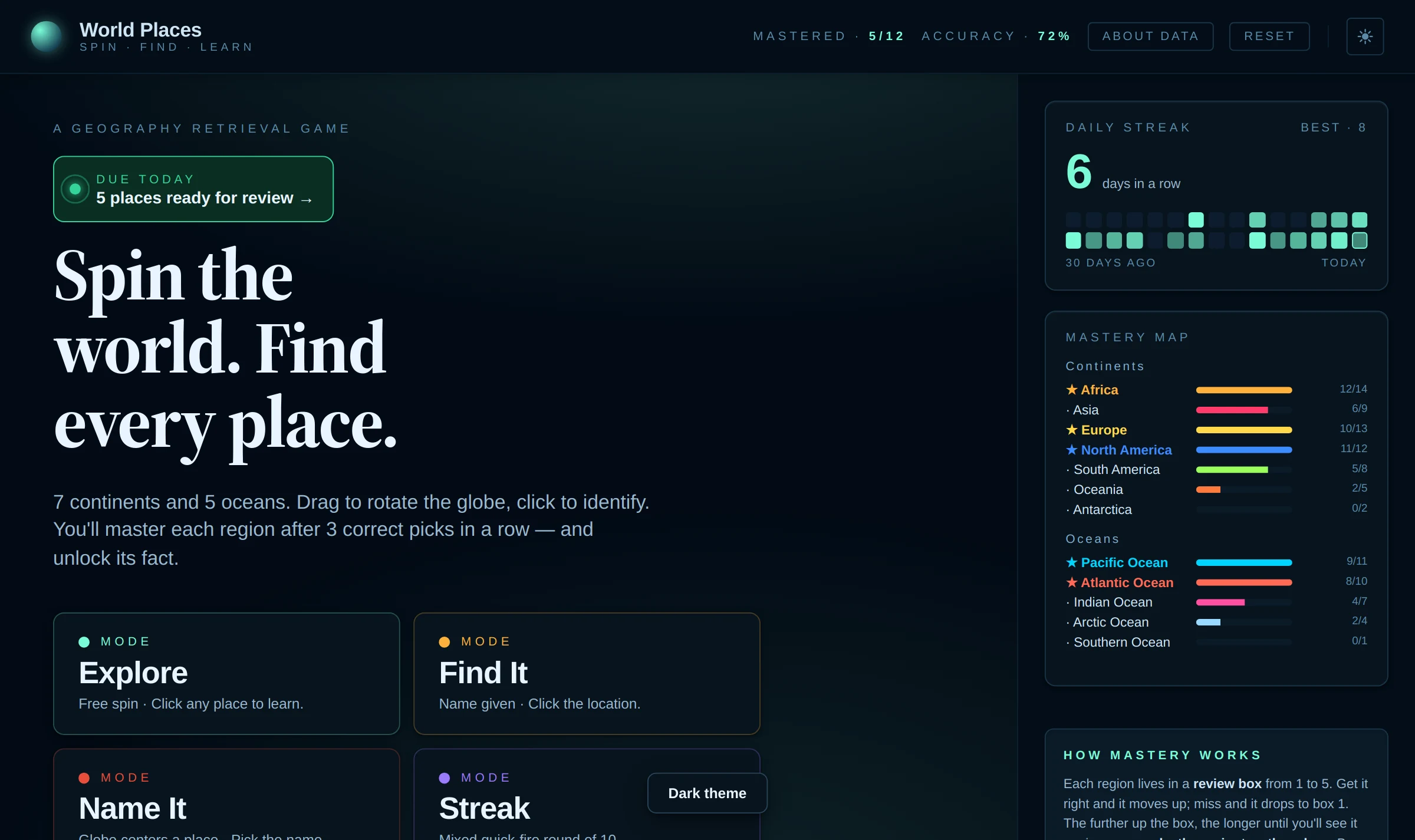
A region only leaves the review pool after three consecutive correct answers, and drops straight back in on a miss. Mastery has to be repeated, not achieved once.
02
Elaborative feedback
Every miss shows the correct location plus direction and distance from the guess. The student leaves with a corrected map, not a red X.
03
One fact per place
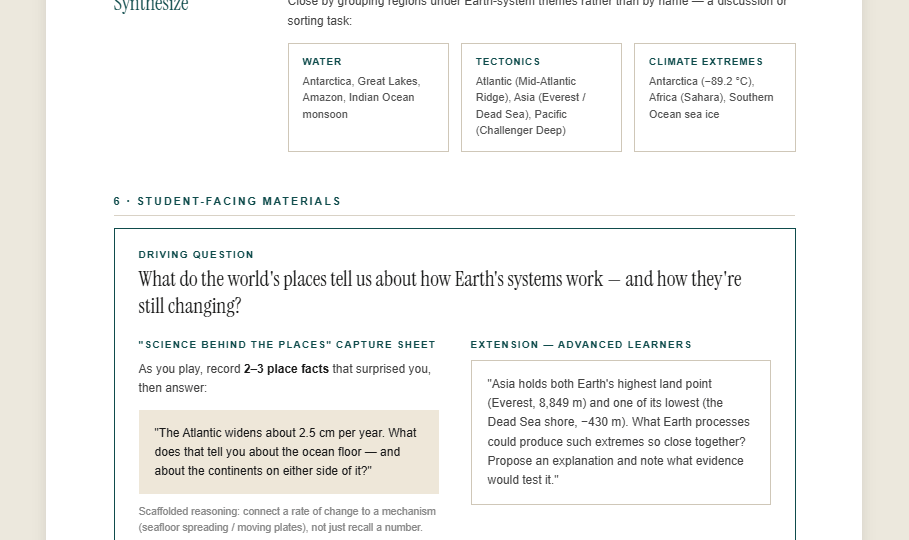
Each region unlocks a single real feature (the Mid-Atlantic Ridge, the Dead Sea shore) so the name has something to hang on beyond its shape.
04: THREE MODES
The same knowledge, tested three ways.
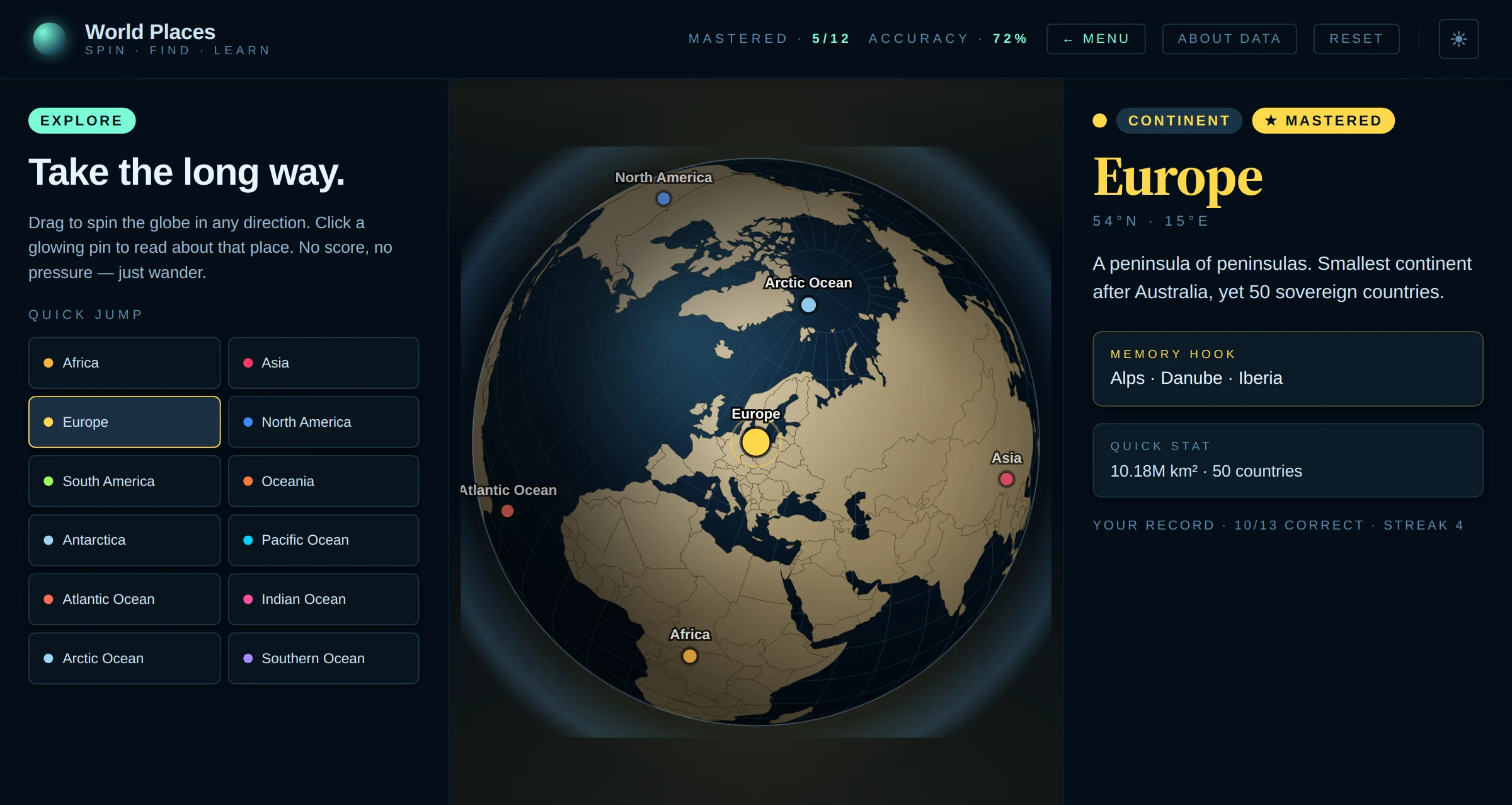
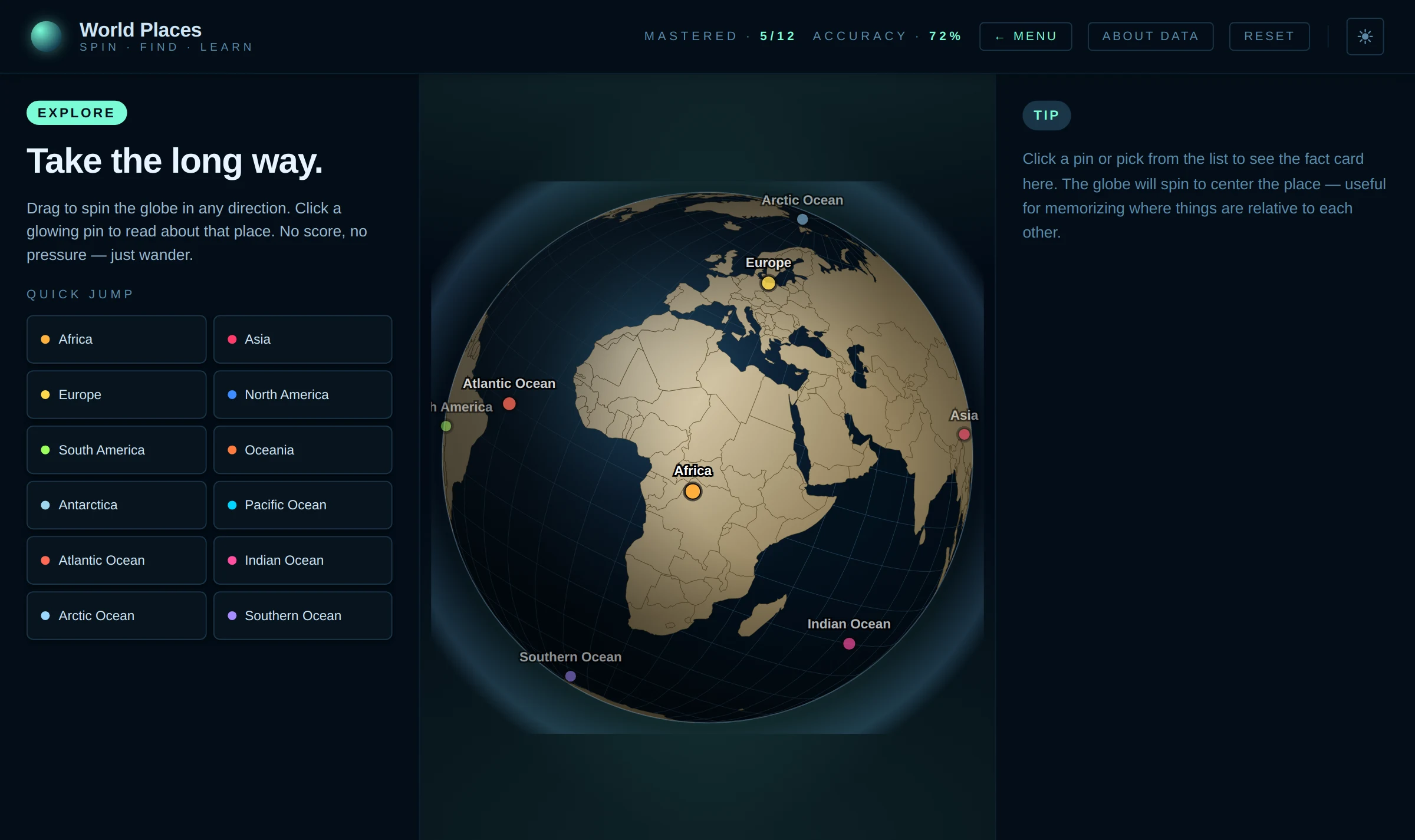
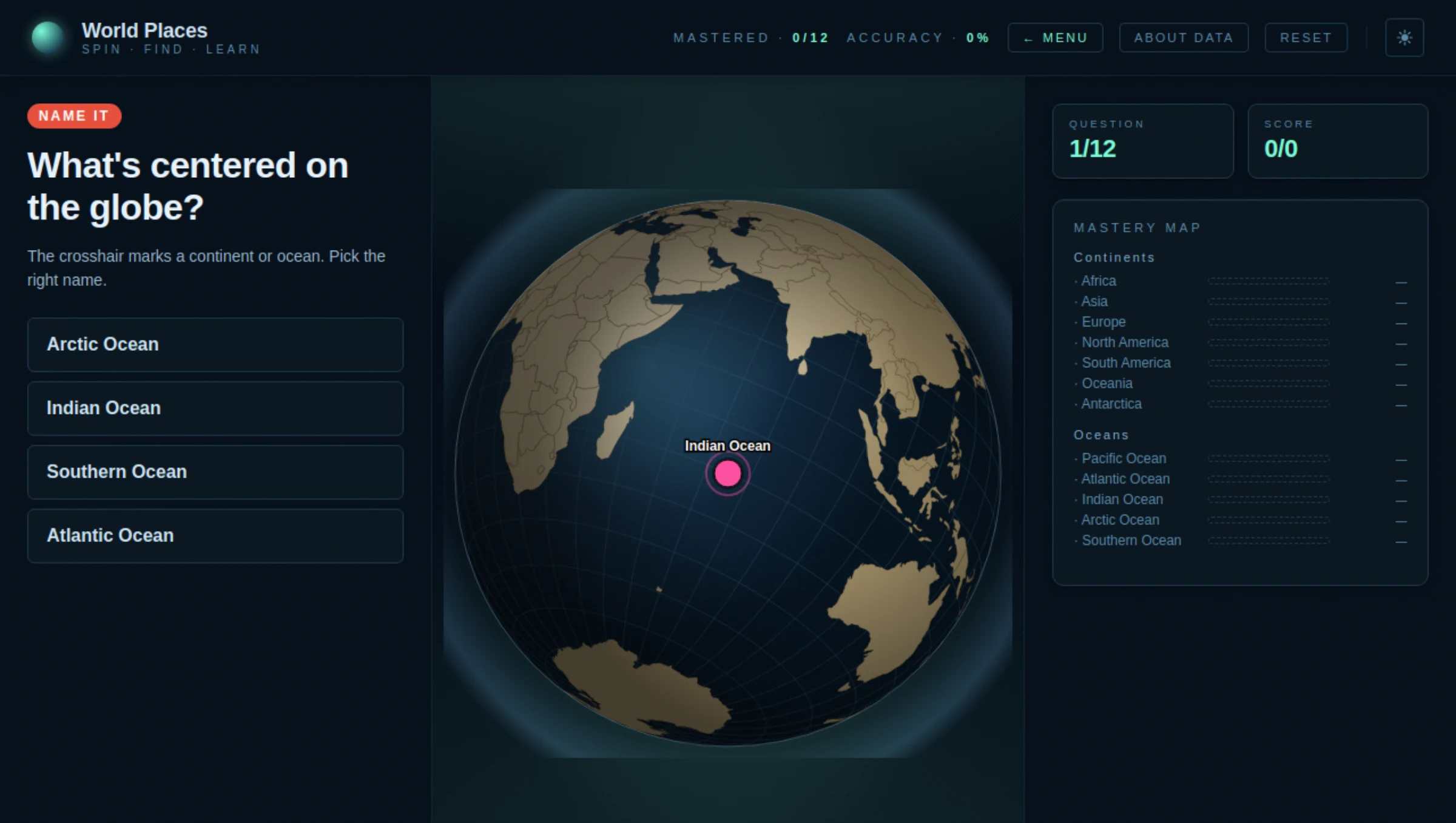
Explore builds the map with no score attached. Find It and Name It then test it in opposite directions, so a student cannot pass by rehearsing one task type.
05: FROM THE WORK
Screens as shipped.
06: OUTCOME
What shipped.
Twelve regions across three retrieval modes on one shared mastery record, playable in a ten-minute window with no install, login, or teacher setup. Keyboard and screen-reader support run at parity with the visual game: the retrieval loop is completely playable non-visually.
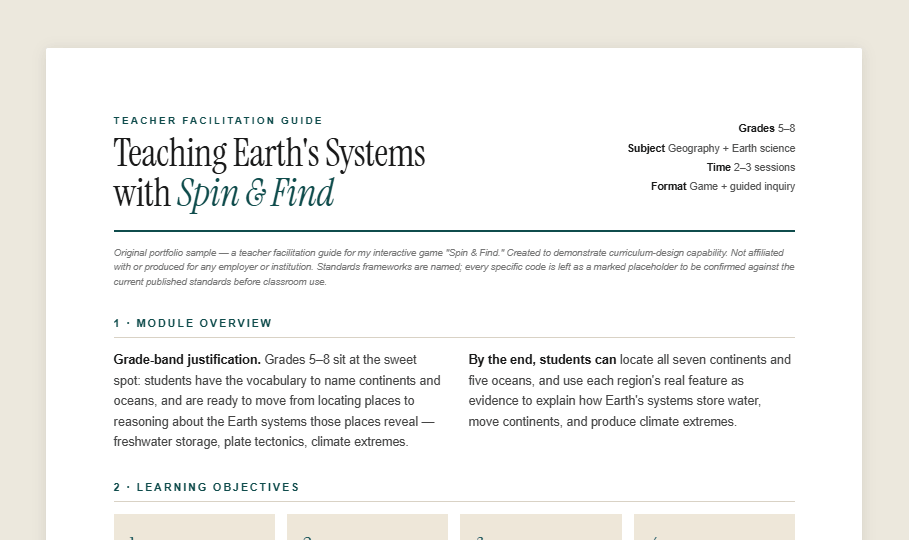
07: THE FACILITATION GUIDE
A game is not a lesson until someone can run it.
Three printable pages: where the game sits in a unit, how to open and close a session, the questions that turn a wrong answer into instruction, and what to look for in the mastery map afterwards.
08: EVALUATION
How I would know whether it worked.
Two of the four Kirkpatrick levels are instrumented in the build itself, because the mastery model already records what a Level 2 assessment would ask. The other two are a stated plan, not a claim; this is a self-initiated portfolio piece and no classroom data has been collected.
| Level | Evidence | Status |
|---|---|---|
| 1: Reaction | Does a student choose to keep playing? Session length and voluntary return within seven days, read from local storage, are a better signal than a smile sheet at this age. | Planned |
| 2: Learning | Regions reaching the three-in-a-row criterion in both directions, plus first-attempt accuracy per region. The mastery map is the assessment; no separate quiz is needed or wanted. | Built in |
| 3: Behaviour | The terminal objective: an unprompted blank-map label two weeks after last practice, on paper, away from the game. Ten of twelve is the threshold that would count as working. | Planned |
| 4: Results | At classroom scale the meaningful result is teacher time reclaimed: minutes of re-teaching geography recall before an assessment, compared against a worksheet-only unit. | Planned |
Formative testing
The design decision I would put in front of learners first is the mastery criterion itself. Three consecutive correct answers is defensible on paper and may still read as punitive in play, particularly when a single miss returns a region to the pool. A one-to-one tryout with four students, watching where they quit rather than asking whether they liked it, is what would settle it.
09: THE COMPANION, WORLD PLACES
A 12-scene animated presentation of the seven continents and five oceans that pairs with the game as a lightweight explainer and onboarding sequence. Built on a reusable scene template: consistent typographic system, entrance animation, one hero stat, one vivid fact per region, with three regions (Asia, Antarctica, Pacific) given bespoke compositions where the template did not serve the content.
It shares the game’s dark and cream visual system and theme toggle, so the two pieces read as one product family.
Spaced retrieval is better felt than read. Spin the globe and test the design yourself.