Companion Piece: Curriculum
What Makes a Cell Work?
Modeling how a cell's parts keep it alive
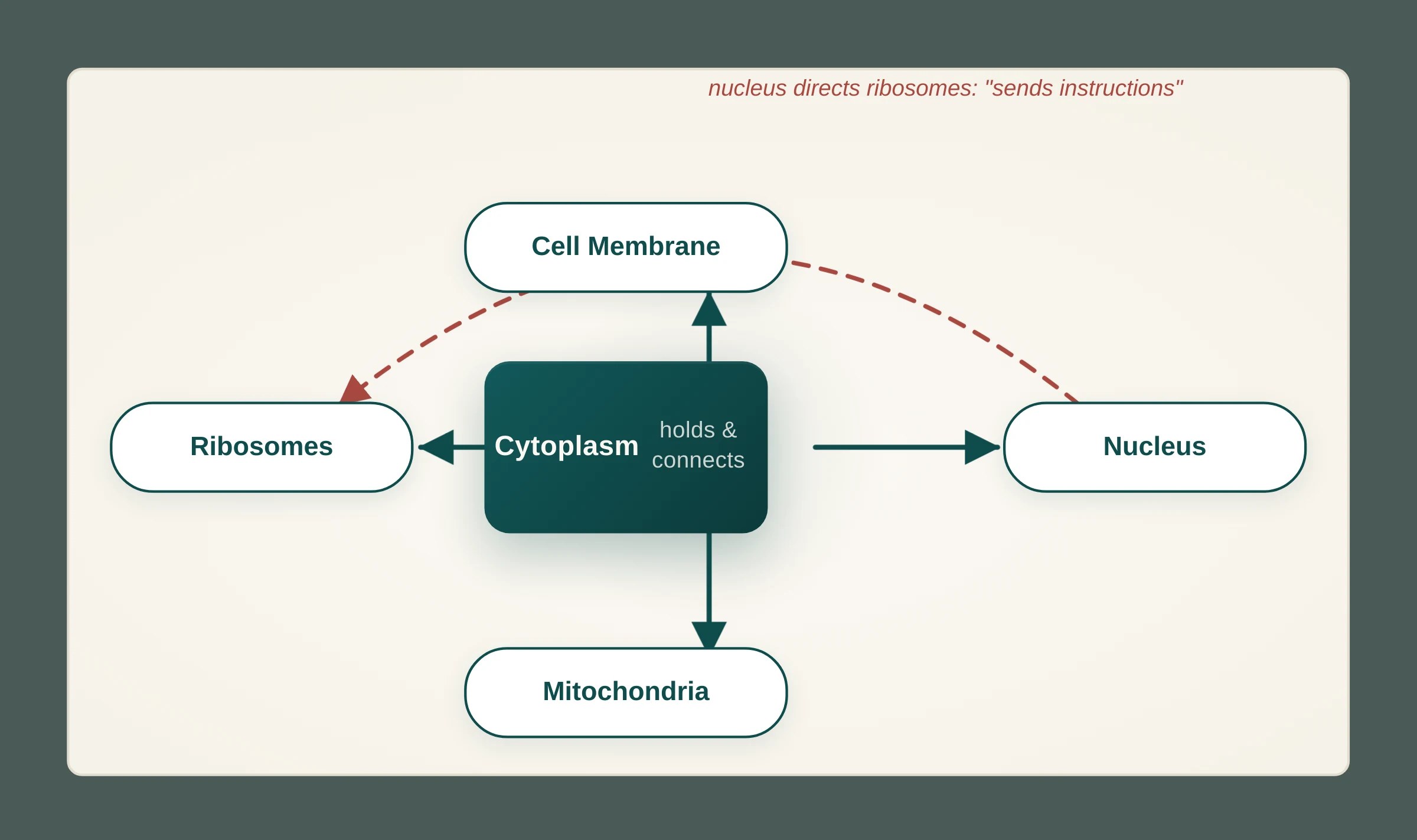 Open the printable packet
01: ANALYSIS
The standard asks for a model. Most cell lessons ask for vocabulary.
NGSS MS-LS1-2 is a modeling performance expectation: describe the function of the cell as a whole and how its parts contribute to that function. That is a systems claim, and it cannot be assessed by a labeling worksheet. The analysis started by reading the standard as the terminal objective and working backwards from what a student would have to produce.
- Learner analysis
- Middle schoolers arrive with a picture-book model of a cell: a blob with named things floating in it. Many can recite that mitochondria make energy without being able to say what would happen to the cell if they stopped. Reading load varies widely inside one class, so anything that requires a paragraph of text before students can act will lose part of the room.
- Task analysis
- Decomposed from the performance expectation: identify a part from its structure, infer a plausible function from that structure, connect the part to at least one other it depends on, then use the whole model to explain a change at the level of the cell. Each step is a prerequisite for the next, which is what fixes the order of the two sessions.
- Root cause
- Not a knowledge deficiency. Students who miss this item usually know the names. What they have never been asked to do is reason across parts: a Mager and Pipe reading that points at the task design rather than at the student or a missing lecture.
- Constraints
- Two 50-minute periods, no microscopes or consumables, printable in black and white, and runnable by a substitute or a teacher outside their subject. The packet had to carry its own pacing, materials list, misconception notes, and rubric, because whoever delivers it may see it for the first time that morning.
Learning objectives
- Understand
- Given a labeled diagram, the student names each part and states what its structure suggests it does, without the function supplied for them.
- Analyse
- The student names one part another part depends on and explains the dependency in a sentence: the smallest unit of systems reasoning the standard requires.
- Evaluate
- Given a part that has stopped working, the student predicts the consequence for the whole cell and justifies it from the model rather than from memory.
- Terminal
- The student uses their own labeled model to write a claim, evidence, and reasoning response explaining how the parts of a cell work together to keep it alive; the performance the standard actually names.
Process model: backward design on a 5E flow
Wiggins and McTighe’s sequence set the order of the work: the CER prompt and its rubric were written first, then the activities that would make a student capable of answering it, then the explanation. The 5E model organizes delivery (engage, explore, explain, elaborate, evaluate) with explore placed before explain so students infer function from structure before a teacher confirms it.
02: THE PROBLEM
Students can label a cell and still not know what a cell does.
The familiar version of this unit ends in a coloring page and a quiz on names. Students pass it, then fail the question that matters: what happens to the cell when one part stops working. The names were never the difficulty.
The second problem is delivery. A lesson that only works when its designer teaches it is not a curriculum product. The packet had to be dense enough to hand over cold and still land the same way in a room I have never seen.
03: THE DESIGN
Structure first, function inferred, then the system.
01
Part cards before answers
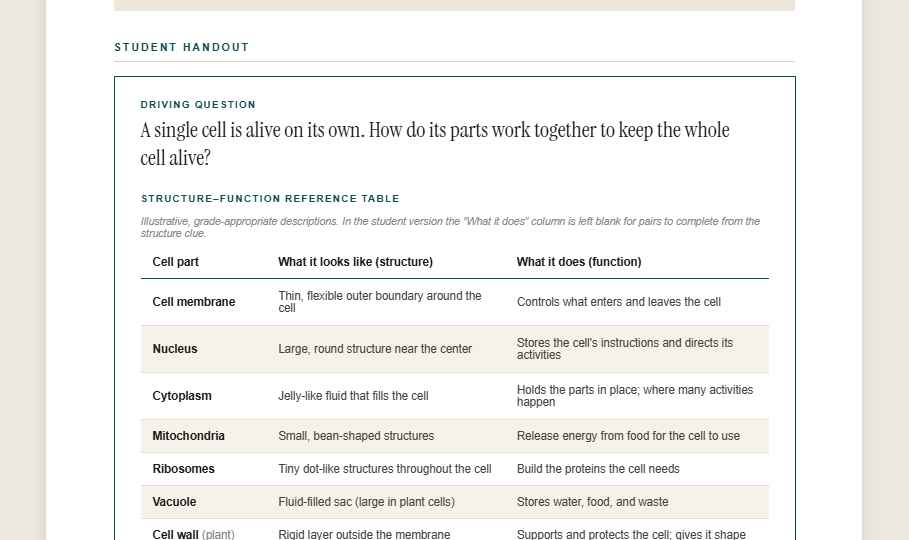
Pairs work from cards that show a part and its structure, not its job. Students propose a function and defend it, which makes the later explanation a confirmation rather than a transcription.
02
Break one part on purpose
The elaborate phase hands each group a failure (the membrane can no longer control what passes through) and asks what happens next. Dependency becomes visible only when something stops.
03
The rubric came first
A four-level CER rubric was written before the activities and printed in the packet, so the standard the work is graded against is the one it was designed against.
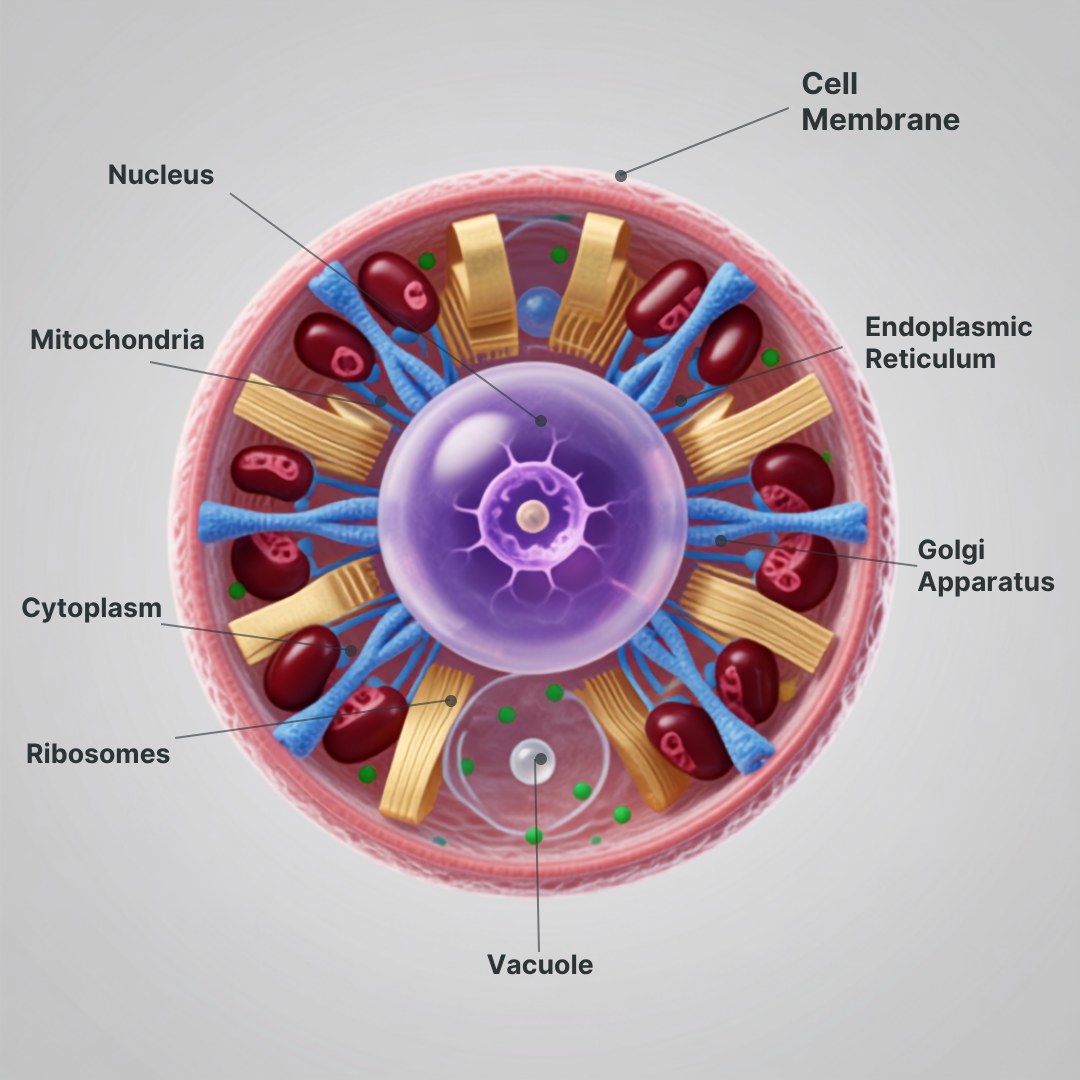
5E flow / two 50-minute sessions
- Engage
- 10 min, session 1. Students sketch their current model of a cell, surfacing the blob-with-names version.
- Explore
- 30 min, session 1. Part cards in pairs: infer function from structure, place each part in the model. The anchor of the unit: protect this time.
- Explain
- 25 min, session 2. Discussion formalizes the structure-to-function links students built, and corrects the predictable misreadings.
- Elaborate
- 15 min, session 2. A what-if-this-part-failed scenario forces reasoning across parts rather than about one.
- Evaluate
- 10 min, session 2. Exit ticket for the teacher’s next move; the model-based CER prompt for the grade.
04: THE PACKET
Three pages, handed over cold.
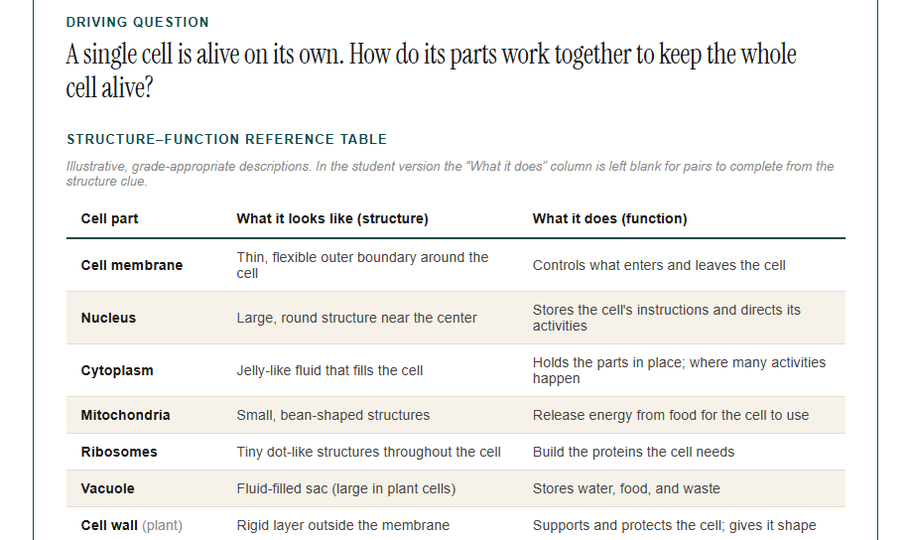
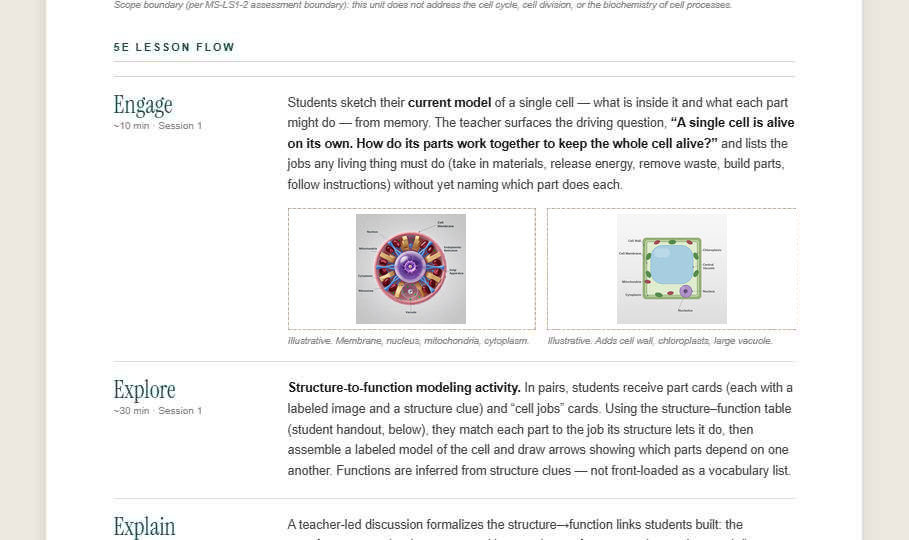
Standards alignment, the 5E flow, teacher guidance, the student handout, and the rubric: printable as it stands.
05: OUTCOME
What shipped.
One document holds the standards alignment, the lesson flow, the student handout, and the assessment. Content stays inside the MS-LS1-2 assessment boundary: no cell cycle, no cell division, no biochemistry of photosynthesis or respiration.
06: EVALUATION
How I would know whether it worked.
The trap in a science unit is grading the artifact instead of the reasoning. A neatly labeled diagram can earn full marks while the student still cannot explain a dependency, which is why the rubric scores the CER response and not the drawing. This is a self-initiated portfolio sample; no classroom data has been collected.
| Level | Evidence | Status |
|---|---|---|
| 1: Reaction | From the teacher, not the students: did the pacing hold, and did the explore phase run without the packet being reinterpreted mid-lesson. A curriculum product’s first usability test is whether the person delivering it had to improvise. | Planned |
| 2: Learning | The exit ticket formatively, the CER prompt summatively against the four-level rubric. The engage sketch doubles as a pre-measure: comparing it with the final model shows movement from a blob with names to a system with dependencies. | Built in |
| 3: Behaviour | A systems question on a later unit (organ systems, or homeostasis) answered without re-teaching the reasoning move. If the structure-to-function habit was learned rather than the cell facts, it should show up where the content is different. | Planned |
| 4: Results | Performance on MS-LS1-2 items at the department level, and teacher preparation time. A packet that removes an hour of planning per teacher per section is the practical result a school notices. | Planned |
Formative testing
The first thing I would test is the explore phase against the clock. Thirty minutes assumes pairs settle on a function quickly; if they stall on the first card, session one ends before the model is built and session two has nothing to formalize. After that, the part cards themselves; whether the structure shown is enough for a plausible inference, or whether some parts have to be given.
The packet is the deliverable. Read it the way a teacher would, cold, the morning it has to run.