Case Study 01: Leadership Simulation
The Change Crucible
No option that costs nothing
01: ANALYSIS
The knowledge was already there. That was the finding.
The request that starts a project like this is usually “build us change management training.” The analysis exists to establish whether training is the right response at all, and here it very nearly was not.
- Learner analysis
- Department chairs and mid-level managers in higher education, most with prior exposure to a change framework and able to name its stages on request. Time-poor, sceptical of role-play, and unwilling to rehearse in front of peers they will negotiate with next week. One sitting, twenty minutes, no cohort.
- Task analysis
- Holding a change conversation under resistance decomposes into three operations: diagnosing which element of adoption is actually missing, choosing a response proportionate to that diagnosis, and absorbing pushback without retreating into concession or authority. The second and third fail far more often than the first.
- Root cause
- Read against Gilbert’s Behavior Engineering Model, knowledge and skill were the least deficient cells. What was missing was practice under consequence; no safe place to make the wrong move and watch the room change. Adding a module on the framework would have been the wrong intervention, which is why this is a simulation and not a course.
- Constraints
- No facilitator, no scheduled cohort, no LMS dependency. Branching had to stay shallow enough for one designer to author every path at full plausibility; an unconvincing branch does more damage than a missing one, because it teaches the learner to game the format.
Learning objectives
- Analyse
- Given a stakeholder’s stated objection, the learner identifies which element of adoption is missing rather than treating all resistance as unwillingness.
- Apply
- In at least two of the three acts, the learner selects a response proportionate to that diagnosis, without defaulting to positional authority or to concession.
- Evaluate
- After a choice resolves, the learner can say why each unchosen option would also have been defensible, and what it would have cost.
- Terminal
- In a real conversation within thirty days, the learner names the missing element to themselves before responding to resistance. This is the behaviour the whole simulation is accountable to.
Process model: SAM, on Merrill's First Principles
The structure is problem-centred: the learner is in the room in the first thirty seconds, activating what they already know about resistance, then watching a demonstration through consequence rather than narration. Each act is application at rising difficulty. Branch plausibility can only be judged by reading it back cold, so authoring ran in short write-review-revise cycles rather than a single design pass. The domain content is ADKAR; the scenario-design rule, no throwaway options, follows Clark’s work on decision-making scenarios.
02: THE PROBLEM
Change management training teaches a model, then tests whether you can name it.
A manager can pass a quiz on the stages of adoption and still freeze in the room where nine faculty are waiting to see how they open. The knowledge is not the gap. The gap is judgment under pressure, with incomplete information and people watching.
Scenario training usually undercuts itself by making one option obviously correct. If the learner can spot the right answer from the wording alone, they are practising test-taking, not leadership.
03: THE DESIGN
Every option is defensible. Every option costs something.
01
No throwaway options
Each response is one a real manager would give, written in their voice. The learner has to weigh trade-offs rather than eliminate obviously wrong answers.
02
Consequence before commentary
The scene plays out first (what the person says next, how the room shifts) and only then does the design insight name the mechanism behind it.
03
Rising pressure across three acts
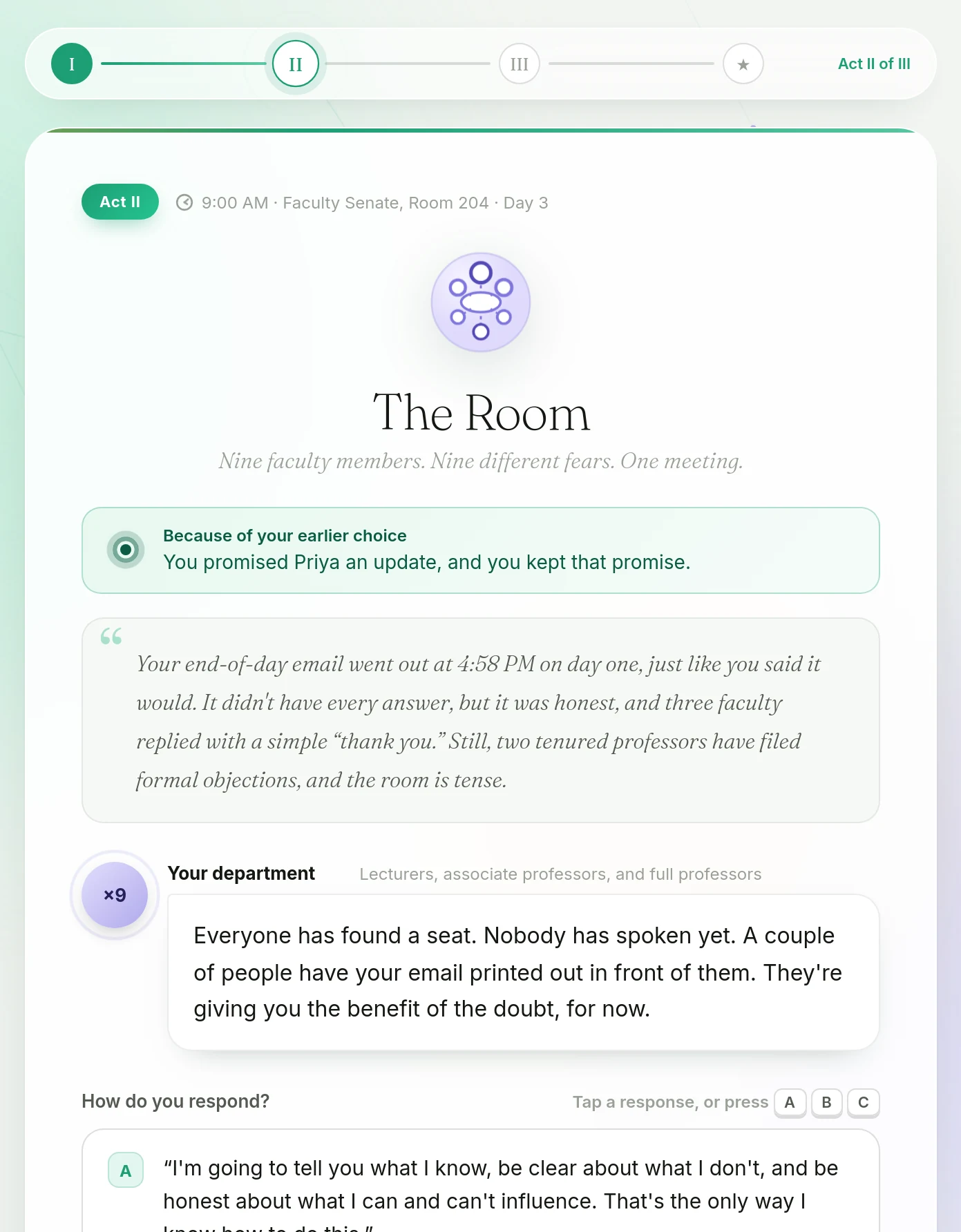
One person, then a room of nine, then a call from the dean with your own credibility on the line. The difficulty is social, not informational.
04: THREE ACTS
The pressure escalates.
Each scene raises the number of people affected and lowers the amount of certainty available.
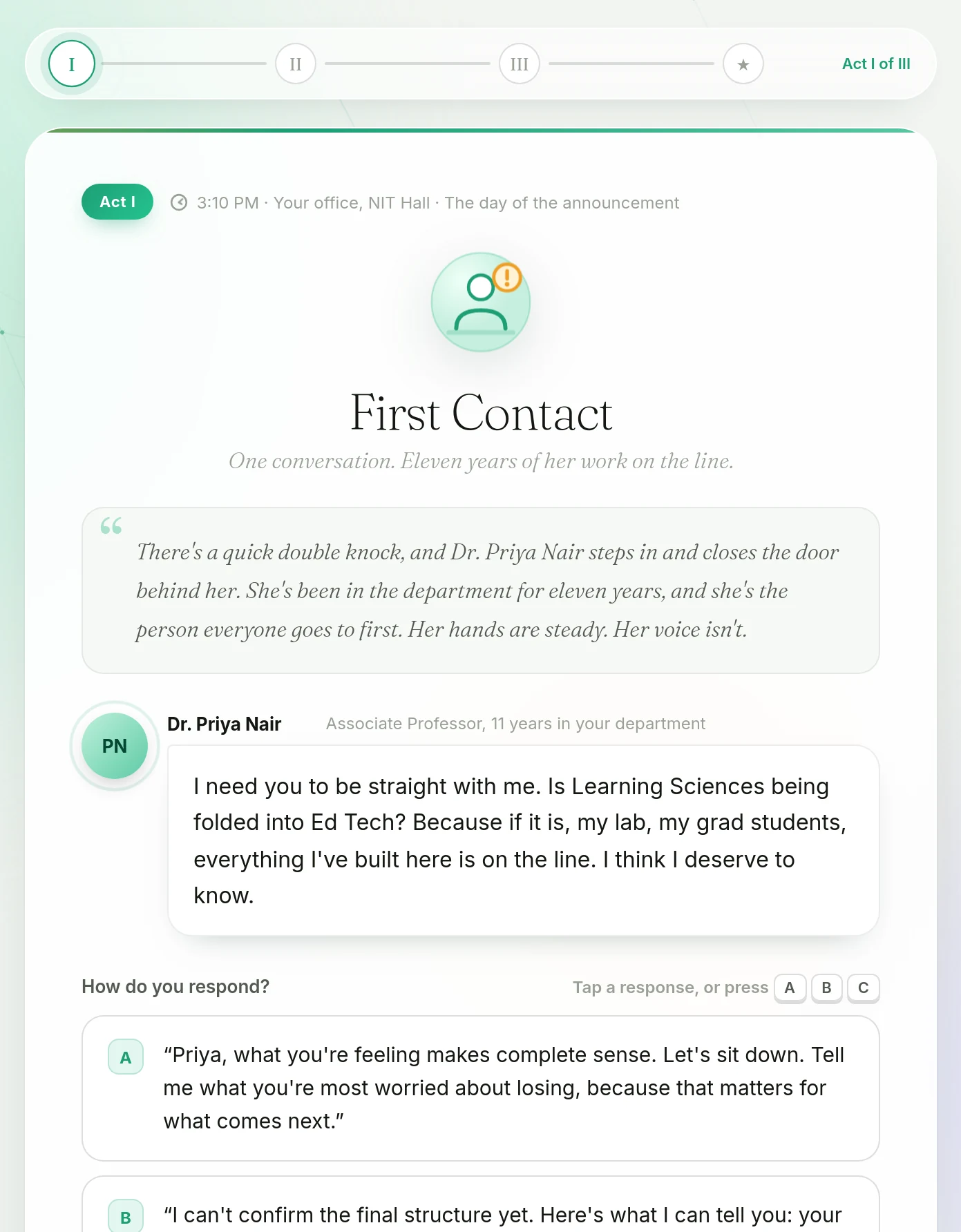
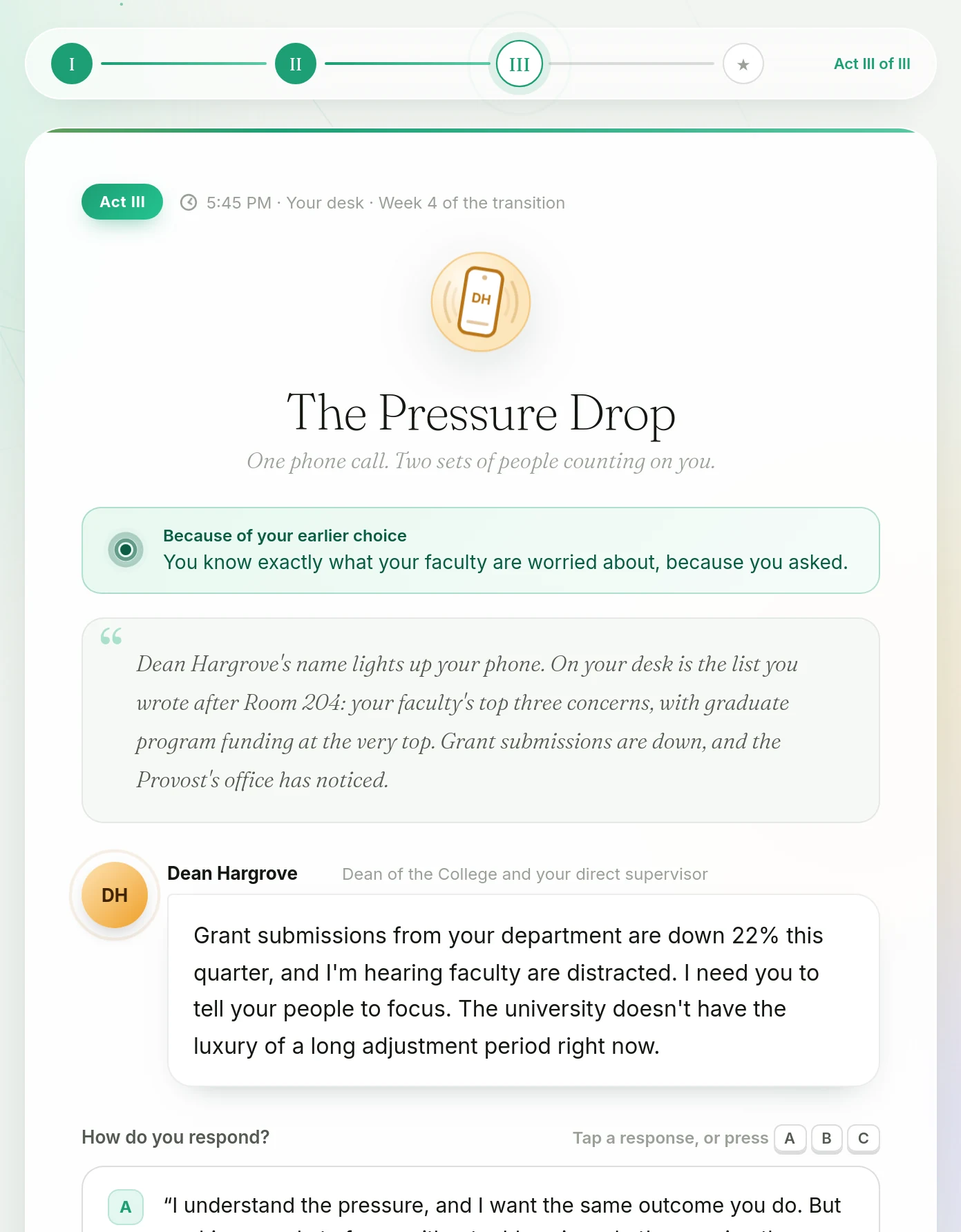
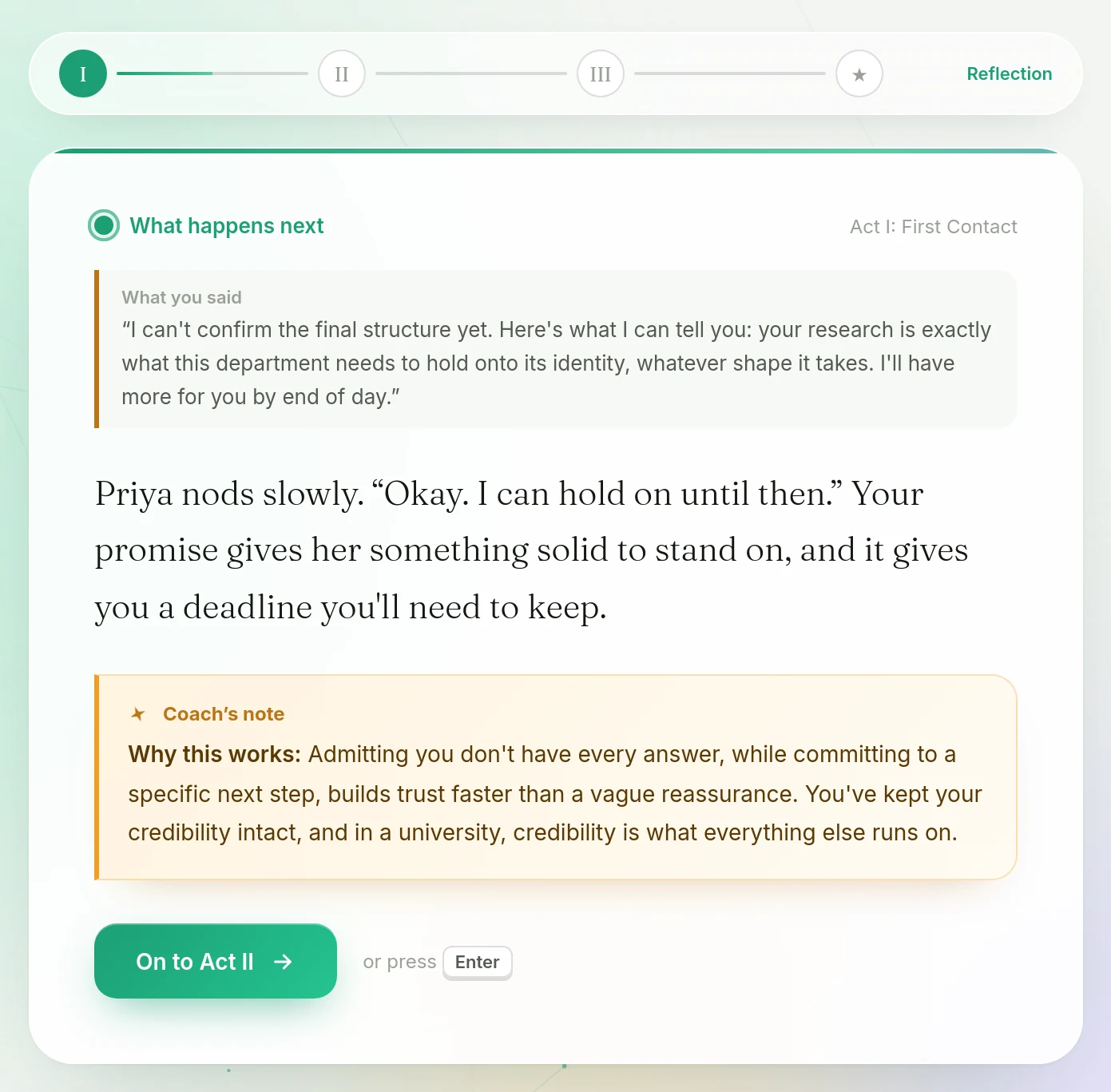
Accessibility, verified. The scenario passes automated WCAG 2.1 AA testing (axe-core) with zero violations on every screen of five different paths, through to the leadership profile, and every choice can be made from the keyboard. Verified September 2026.
05: OUTCOME
What shipped.
Three scenes of rising social pressure, nine named faculty with distinct positions and loyalties, and no cost-free choices: every path trades something away.
The design insight panel after each choice is what makes it training rather than fiction: it names the mechanism the learner just used, so the judgment transfers to a room that looks nothing like this one.
06: EVALUATION
How I would know whether it worked.
A branching simulation is easy to evaluate badly. Satisfaction runs high on this format whether or not anything transfers, which makes reaction data the least useful thing to collect and the easiest to mistake for success. This is a self-initiated portfolio piece; no organisational data has been collected.
| Level | Evidence | Status |
|---|---|---|
| 1: Reaction | Not satisfaction: plausibility. The question worth asking a manager is whether they recognise the scene: have you had this exact conversation? A scenario that scores well on enjoyment and badly on recognition has failed. | Planned |
| 2: Learning | The path is the assessment. Which act a learner first diagnoses correctly, and whether they revert to positional authority once Act III raises the stakes, measures judgment more finely than a post-test could. | Built in |
| 3: Behaviour | The terminal objective, thirty days out: a short structured self-report paired with one observation from the learner’s own manager. On a judgment skill, self-report alone is not evidence. | Planned |
| 4: Results | Tied to the initiative the manager is actually running: adoption rate and the volume of escalations reaching the sponsor. I would report this as correlation against a comparable unit, not attribution. | Planned |
Formative testing
The first thing I would watch is whether the design insight panel gets read or clicked past. It carries the entire instructional payload and it arrives at the moment the learner most wants to move on. If a one-to-one tryout shows managers skipping it, the fix is structural; the insight has to be earned inside the scene rather than appended after it.
The scenes are the argument, and the facilitator guide is what runs them. Play the scenario and see what each choice costs.