
The short version
- A pilot proves a tool can work. A rollout proves people will use it on an ordinary Tuesday. Those are different tests.
- Most rollout plans spend almost everything on training and almost nothing on what happens after launch.
- ADKAR breaks adoption into five states. Training addresses one of them.
- The strongest predictor of adoption is a sponsor still visibly using the tool in month four.
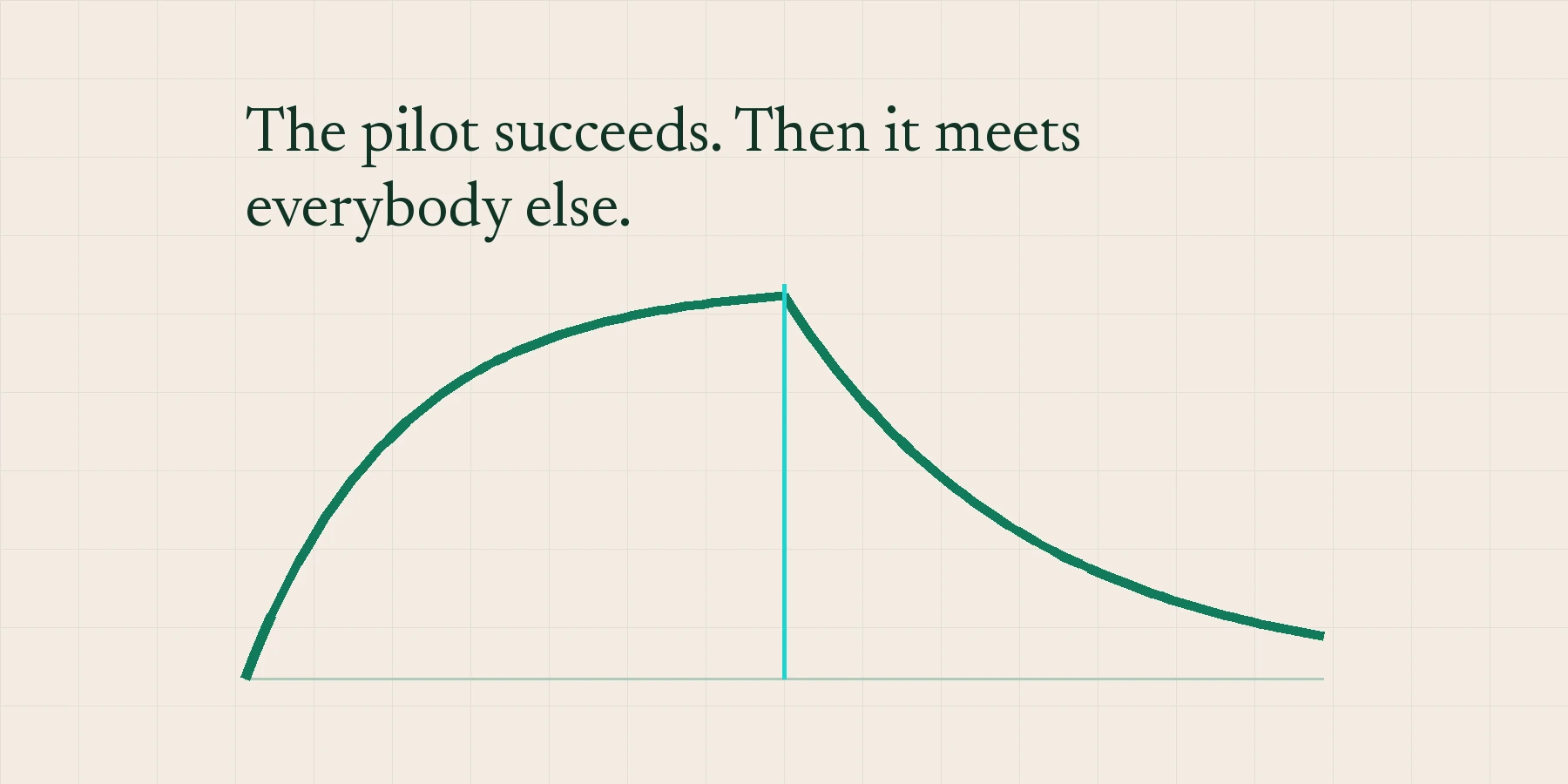
Most AI pilots do not fail on the model. They fail in the ninety days after the demo, when something that worked in a controlled test has to survive contact with a real workday.
I have watched this pattern repeat across financial services, healthcare, government, and education. The proof of concept lands well. Leadership is convinced. Budget gets approved. Then the tool ships to three hundred people who were never asked what their Tuesday actually looks like, and usage flattens at the exact point the project plan predicted acceleration.
The demo is not the hard part
A pilot is designed to remove friction. You pick motivated participants, you sit in the room, you fix problems in real time. That is the right way to test whether a capability exists.
It is a poor way to predict what happens at scale, because every condition that made the pilot succeed is absent at rollout. The motivated volunteers are replaced by everyone. The person who fixed problems in real time is now managing three other projects. The tool competes with a habit that already works well enough.
Where the plan usually runs out
Open most enterprise rollout plans and you will find a detailed training schedule, a communications calendar that ends the week of go-live, and almost nothing after that.
That shape makes sense if you believe the barrier to adoption is knowledge. Usually it is not. The people who abandon a new tool in month two can generally explain exactly how it works. They just have a faster way to finish the task, and nobody is asking them about it anymore.
A rollout plan that ends at go-live was never a rollout plan. It was a launch plan wearing a rollout plan’s clothes.
What ADKAR adds that a training plan does not
ADKAR is a change management model from Prosci that breaks individual adoption into five sequential states: awareness that a change is coming, desire to take part in it, knowledge of how, ability to perform it in practice, and reinforcement that keeps it in place.
The useful part is the sequencing. Training delivers knowledge, the third state. If awareness and desire were never built, a well-designed course lands on someone who understands the tool and still has no reason to switch. And if reinforcement is missing, ability decays quietly over the following quarter while the dashboard still reports a successful launch.
The month-four test
Here is the diagnostic I use. Four months after go-live, can you name a specific executive who is visibly still using the tool, in a way their organization can observe, without being prompted?
If the answer is no, the adoption number is going to decline regardless of how good the training was. If the answer is yes, most of the other problems are recoverable.
The fix is rarely more training. It is a named sponsor with something specific to do past launch, and a manager layer given a clearer instruction than “encourage adoption.”